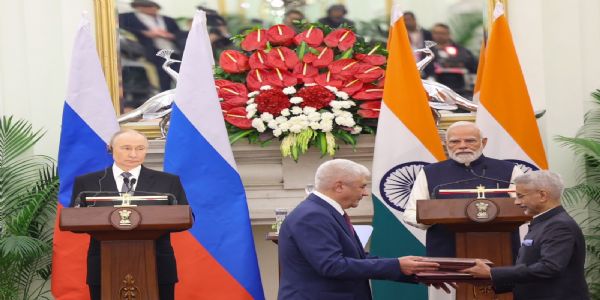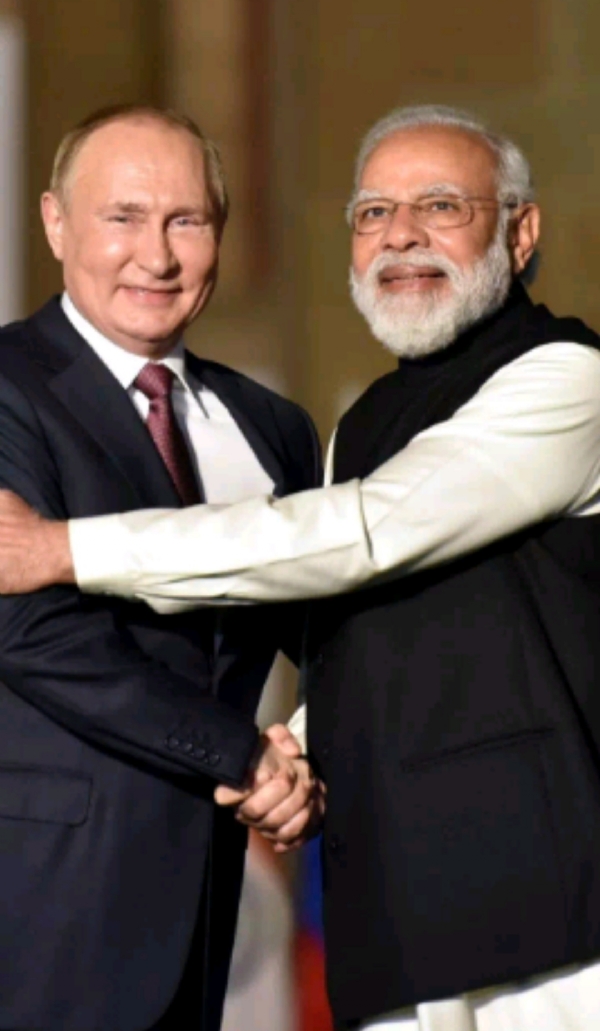
New Delhi, 4 December (H.S.): Russian President Vladimir Putin is scheduled to land in New Delhi on Thursday evening, beginning a two-day state visit for the 23rd India–Russia Annual Summit, his first trip to India since the Ukraine war began in 2022. Within hours of arrival, he will attend a private dinner hosted by Prime Minister Narendra Modi, before receiving a ceremonial welcome at Rashtrapati Bhavan on Friday morning.
Putin’s programme on Friday includes paying homage at Mahatma Gandhi’s memorial at Rajghat, formal summit talks at Hyderabad House, and a state banquet hosted by President Droupadi Murmu at Rashtrapati Bhavan.
Officials have also indicated he will participate in a business-focused engagement with Indian CEOs and is expected to attend an event at Bharat Mandapam, underscoring the economic and investment dimension of the visit.
Five-layer security and ‘fortress-on-wheels’
Given the intensity of Putin’s schedule and global security concerns, Indian and Russian agencies have erected a five-layer security ring around the visit. Highly trained personnel from Russia’s Presidential Security Service, India’s National Security Guard (NSG), Delhi Police and the Special Protection Group (SPG) are jointly sanitising routes, hotels and all key venues linked to the Russian President’s movements.
Snipers, specialised surveillance drones, electronic jammers, AI-enabled monitoring and facial-recognition cameras are being used to maintain real-time situational awareness along the cavalcade route and at fixed locations.
A centrepiece of the security detail is Putin’s Aurus Senat armoured limousine, often described as a “fortress on wheels”, which has been flown in from Moscow specifically for the India visit.
Defence agenda: from Su-57 to spares
Defence cooperation will be at the heart of Modi–Putin discussions, as India continues to rely on Russian-origin platforms even while diversifying its arms purchases.
New Delhi needs assured supplies of spares and maintenance support for systems such as the Sukhoi-30 fighter fleet and the S-400 air defence system, at a time when Russia’s own industrial capacity is stretched by the war.
Kremlin spokesperson Dmitry Peskov and Indian officials have signalled that the possible supply of Su-57 fifth-generation fighter jets will figure in the talks, though any acquisition is seen more as a long-term prospect than an immediate purchase.
The two sides are also expected to push joint manufacturing and technology-sharing under the “Make in India” framework, including expansion of existing projects in land systems, aerospace and naval platforms.
Energy, oil and sanctions pressure
The summit comes as India seeks to balance its energy security needs with the impact of US sanctions on trade and financial channels with Russia.
India has become one of the largest buyers of discounted Russian crude since 2022, but the resulting trade imbalance—with a sizeable deficit in Russia’s favour—has prompted New Delhi to push for more diversified Russian investments and market access.
Talks are expected to cover mechanisms to shield bilateral trade from secondary sanctions, including local-currency settlement and alternative payment channels.
In addition, Moscow is reportedly offering small modular nuclear reactors and wider civil nuclear cooperation, which India sees as a way to bolster long-term energy security while managing emissions and fuel diversification.
Labour mobility, trade targets and new dealsBeyond hydrocarbons and defence, negotiators are working on agreements that could ease the movement of Indian workers and professionals to Russia, reflecting growing demand in sectors such as construction, services and healthcare.
The two governments are also expected to discuss India’s proposed free trade agreement with the Eurasian Economic Union, which could lock in preferential access for Indian goods and services in the wider region.
Strategically, both sides have previously articulated an ambition to raise bilateral trade to around 100 billion dollars by 2030, up from current levels driven largely by oil.
Any announcement on new defence contracts, energy partnerships, or connectivity and logistics initiatives will be closely watched for signals on how resilient the economic relationship remains under Western financial pressure.
Europe’s quiet push on Ukraine
Putin’s presence in Delhi has prompted an unusual diplomatic campaign from European capitals, many of which have privately urged India to use its leverage with Moscow to nudge the Russian leader towards ending the Ukraine war.
Envoys and senior officials from several European countries, including those in eastern Europe, have conveyed to South Block that they view the conflict as an existential threat to European security and see New Delhi as one of the few actors able to speak frankly to Putin.
This messaging marks a shift from early-war demands that India “choose a side” and condemn Moscow, towards a more pragmatic appeal for New Delhi to encourage a negotiated settlement in line with Modi’s public stance that “this is not an era of war”.
At the same time, joint opinion pieces by British, French and German ambassadors, sharply critical of Russia’s actions, have irritated sections of the Indian establishment, which view such public interventions on the eve of a major bilateral visit as diplomatically insensitive.
India’s balancing act between partners
Since 2022, Modi and Putin have reportedly spoken or met more than a dozen times, with India insisting it maintains “strategic autonomy” while simultaneously deepening ties with the United States and Europe.
India has abstained on multiple UN resolutions regarding Ukraine, condemned specific atrocities such as the Bucha killings, and quietly engaged Moscow and Kyiv on issues ranging from nuclear plant safety to the Black Sea grain corridor.
This week’s summit will again test India’s dual-track approach: leveraging discounted Russian energy and legacy defence links, while managing US sanctions, EU expectations and a new, more protectionist trade environment in Washington.
Diplomats say Modi is likely to reiterate that a durable peace in Europe requires dialogue among all principal stakeholders—Ukraine, Russia, Europe and the US—even as India avoids any role that could be construed as formal mediation.
---------------
Hindusthan Samachar / Jun Sarkar