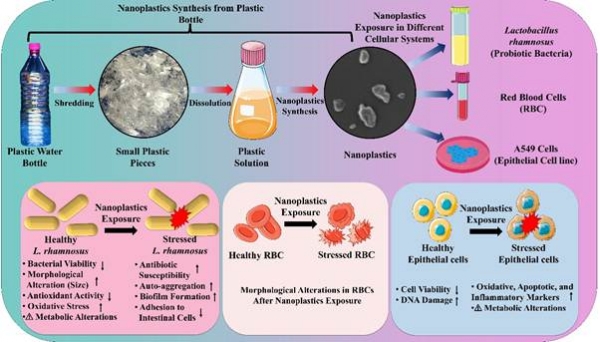
New Delhi, 4 December (H.S.): A groundbreaking study has revealed that nanoplastics released from single-use polyethylene terephthalate (PET) bottles can inflict severe damage on beneficial gut microbes, red blood cells, and human cellular functions, posing significant health risks.
Researchers at the Institute of Nano Science and Technology (INST), Mohali—an autonomous institution under the Department of Science and Technology—demonstrated that these ultra-fine plastic particles disrupt key biological systems. The team, led by Dr. Prashant Sharma, found that prolonged exposure impairs the growth and protective roles of probiotic bacteria like Lactobacillus rhamnosus, while heightening stress responses and antibiotic sensitivity.
In laboratory tests mimicking real-world conditions, nanoplastics damaged red blood cell membranes, altered hemolysis processes, and triggered DNA damage, oxidative stress, apoptosis, and inflammatory signaling in human epithelial cells. High concentrations also disrupted energy metabolism and nutrient processing, confirming these particles as biologically active threats rather than inert waste.
The findings, published in Nanoscale Advances by the Royal Society of Chemistry, underscore nanoplastics' potential to undermine immunity, metabolism, and mental health via gut microbiome disruption. As these pollutants accumulate in food, water, and human tissues, the study calls for urgent research into long-term effects like bioaccumulation and systemic toxicity.
The Union Ministry of Science and Technology highlighted the research's broader implications for human health, agriculture, and ecosystems on Thursday.
---------------
Hindusthan Samachar / Jun Sarkar