




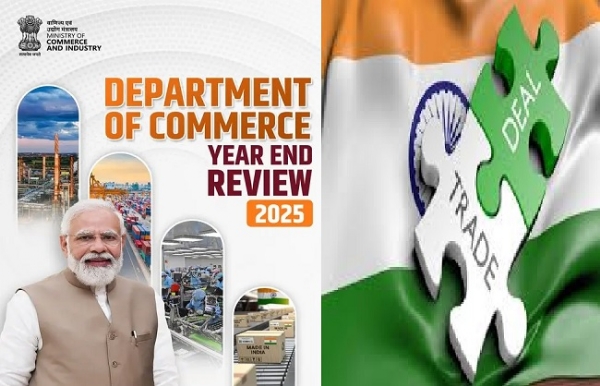
New Delhi, 23 December (H.S.): The Ministry of Commerce and Industry announced on Monday that India and New Zealand have successfully concluded negotiations for a Free Trade Agreement (FTA), marking a major milestone in India’s trade diplomacy this year.
With this, India has finalized three significant trade agreements in 2025 — with the United Kingdom, Oman, and now New Zealand.In July 2025, India signed the Comprehensive Economic and Trade Agreement (CETA) with the United Kingdom, followed by the Comprehensive Economic Partnership Agreement (CEPA) with Oman on December 18.
Following the conclusion of FTA talks with New Zealand, Union Minister for Commerce and Industry Piyush Goyal described it as a “comprehensive and forward-looking” agreement that would enhance opportunities for Indian farmers and the dairy sector.
He noted that the FTA, completed within nine months, is India’s seventh major trade deal signed under Prime Minister Narendra Modi’s leadership over the last five years. Notably, all three of these 2025 trade deals involve developed countries.
India’s Best-Ever Export Performance in FY2025–26 (First Half)India achieved a record export performance in the first half of FY2025–26, backed by structural reforms and new market access through recent trade deals.
The government unveiled a ₹25,060-crore Export Ecosystem Transformation Mission, aimed at strengthening India’s export competitiveness and digital trade frameworks.
According to Commerce Ministry data, India’s total exports (goods and services) reached an all-time high of USD 825.25 billion in FY2024–25, registering a robust 6.05% year-on-year growth. This upward momentum continued into FY2025–26, with exports rising to USD 418.91 billion during April–September 2025, a 5.86% increase over the same period last year — making it the highest-ever export level for any half-year period.
Specifically, merchandise exports stood at USD 219.88 billion during April–September 2025, up by 2.90% year-on-year. Key growth drivers included electronics (41.94%), engineering goods (5.35%), pharmaceuticals (6.46%), marine products (17.40%), and rice (10.02%).
Strong demand from the United States (13.34%), UAE (9.34%), China (21.85%), Spain (40.30%), and Hong Kong (23.53%) also contributed significantly to the surge.
The Government e-Marketplace (GeM) platform emerged as India’s largest procurement portal, achieving a gross merchandise value (GMV) of ₹16.41 lakh crore. At the same time, digital trade reforms streamlined compliance and trade intelligence systems.
The Ministry of Commerce emphasized that the India–New Zealand FTA is broad, balanced, and future-ready, aligning with India’s “Developed India @2047” national vision. It is one of the fastest-concluded FTAs with a developed nation, underscoring India’s proactive trade policy.
The India–UK CETA signed earlier this year grants tariff-free access to 99% of Indian goods, paving the way for bilateral trade worth USD 100 billion by 2030. The recently signed India–Oman CEPA will further deepen India’s strategic partnership in the Gulf region.
In addition to these, India has active agreements with the UAE (CEPA), Australia (ECTA), and the European Free Trade Association (EFTA). These pacts have significantly expanded India’s reach across the US, EU, GCC, and Asia-Pacific regions.
India is concurrently negotiating several high-level trade deals, including:
India–EU Free Trade Agreement (FTA)
India–US Bilateral Trade Agreement (BTA)
India–Australia Comprehensive Economic Cooperation Agreement (CECA)
India–Chile FTA
India–Korea CEPA (under review)
India–Peru FTA
India–Sri Lanka Economic and Technology Cooperation Agreement (ETCA)
India–Eurasian Economic Union (EAEU) FTAIndia–Maldives FTAASEAN–India Trade in Goods Agreement (AITIGA)
Export Promotion Mission: A Vision for Developed India 2047The Commerce Ministry’s ambitious Export Promotion Mission (EPM) aims to improve India’s export competitiveness through coordination between the Department of Commerce, MSME Ministry, Finance Ministry, Export Promotion Councils, commodity boards, industry associations, and state governments.
The mission reflects a forward-looking policy reform designed to align India’s trade framework with the goal of becoming a technologically advanced, globally competitive, developed economy by 2047.
---------------
Hindusthan Samachar / Jun Sarkar


23 Dec 2025
Hajime Ota Appointed as New Chairman of Yamaha Motor India Group, to Assume Office from January 1
23 Dec 2025
