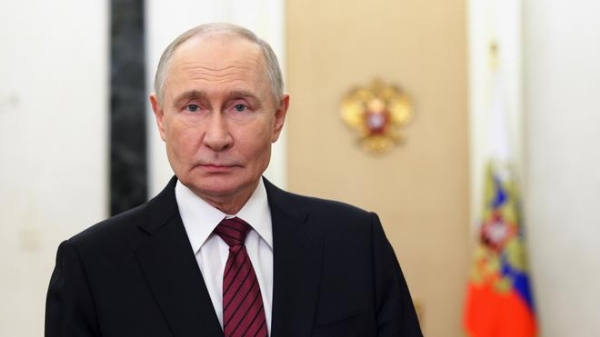
WASHINGTON/PARIS, 21 December (H.S.): Fresh US intelligence assessments conclude that Russian President Vladimir Putin has not abandoned his long-term goal of seizing all of Ukraine and reasserting control over parts of Europe once under Soviet rule, despite active peace talks that would leave Moscow with far less territory.
Six sources familiar with classified reporting said the latest analysis, circulated in late September, sharply diverges from the narrative promoted by US President Donald Trump and his peace negotiators, who insist Putin wants to end the war.
US analysts say their findings have remained consistent since Russia launched its full-scale invasion in 2022 and largely mirror the views of European allies who believe Putin covets all of Ukraine and has ambitions in former Soviet bloc states, including NATO members in Eastern Europe.
“The intelligence has always been that Putin wants more,” US Congressman Mike Quigley, a Democratic member of the House Intelligence Committee, told Reuters, adding that Europeans, especially Poland and the Baltic states, are convinced they could be next if Ukraine falls.
Russia currently controls about 20 percent of Ukrainian territory, including most of Luhansk and Donetsk in the Donbas industrial region, parts of Zaporizhzhia and Kherson, and the annexed Crimean Peninsula.
Putin claims Crimea and all four partially occupied regions as Russian, while Trump’s team is pressing Kyiv to withdraw from the small portion of Donetsk it still holds as part of a proposed settlement – a demand President Volodymyr Zelenskyy and most Ukrainians strongly reject.
The White House argues it has made “tremendous progress” toward ending the war, with Trump declaring a deal is “closer than ever before,” but officials have not publicly addressed the conflicting intelligence picture.
In a post on X on Saturday, Director of National Intelligence Tulsi Gabbard told lawmakers that Russia “seeks to avoid a larger war with Europe” and that its forces’ mixed performance shows Moscow currently lacks the capacity to overrun “all of Ukraine, let alone Europe,” even while intelligence indicates its objectives have not fundamentally changed.
Trump’s chief negotiators – his son-in-law Jared Kushner and billionaire real estate developer Steve Witkoff – have been working for weeks on a 20-point peace plan with Ukrainian, Russian and European officials.
After talks in Berlin on Monday, negotiators reached broad agreement on robust US-backed security guarantees for Ukraine that would come into force after a peace deal, though major gaps remain on the core issue of territory.
Diplomats say the emerging framework envisages the deployment of a mostly European security force in neighbouring countries and in non-frontline areas of Ukraine to help repel any future Russian attack, alongside a cap on Ukraine’s armed forces at around 800,000 troops. Several diplomats say Russia is pushing for a lower troop ceiling and that the US is open to adjustments, while Washington would bolster the guarantees with intelligence support and US-backed air patrols over Ukraine, subject to ratification by the US Senate. According to some sources and one European diplomat, the strength of the security guarantees could hinge on Zelenskyy agreeing to cede territory to Russia, though others insist alternatives are still being explored because Kyiv has categorically ruled out land concessions.
Zelenskyy voiced caution on Thursday, telling reporters there is “a question I still cannot get an answer to: What will these security guarantees actually do?” as he weighs the political and security risks.Whether Putin would accept such a package remains unclear, given his long-standing opposition to any foreign troop presence in Ukraine and insistence on his maximalist terms.
At his annual news conference on Friday, he offered no substantive compromise, saying his conditions must be met and boasting that Russian forces have advanced 6,000 square kilometres this year, while still professing readiness to discuss peace.
Some in Trump’s administration privately concede that the Kremlin leader may not settle for less than his initial aim of dominating Ukraine. “I don’t know if Putin wants to do a deal or Putin wants to take the whole country. These are things that he has said openly,” US Secretary of State Marco Rubio said on Friday, noting that Russia has yet to achieve the objectives it set at the start of the invasion.
---------------
Hindusthan Samachar / Jun Sarkar