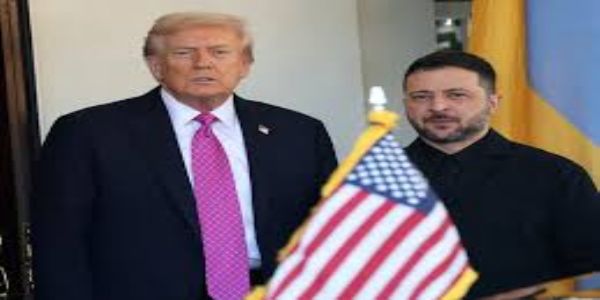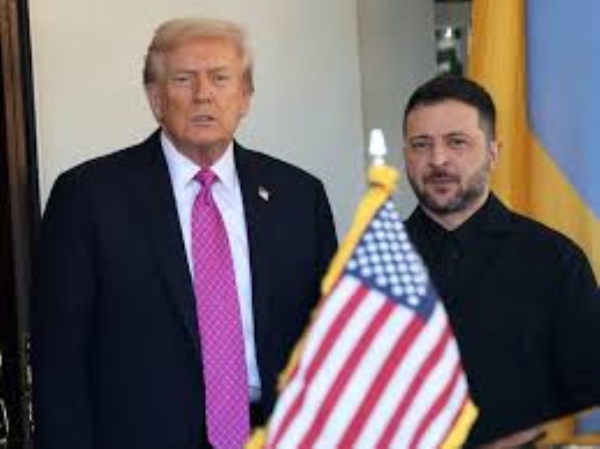
Kyiv, 11 December (H.S.): U.S. President Donald Trump said he and European leaders discussed proposals to end the war in Ukraine in “pretty strong terms” on Wednesday, adding that President Volodymyr Zelenskyy “has to be realistic” about Kyiv’s position in ongoing peace efforts.
As Washington steps up pressure for a settlement, the leaders of Germany, Britain and France held a phone call with Trump and requested a meeting with the U.S. and Ukraine this weekend. “We’ll make a determination depending on what they come back with,” Trump told reporters at the White House.
Zelenskyy earlier said Ukraine was expected to submit its latest peace proposals to U.S. negotiators ahead of his talks on Thursday with leaders and officials from around 30 countries backing Kyiv. Germany’s Friedrich Merz, Britain’s Keir Starmer and France’s Emmanuel Macron called the moment “critical” for negotiations.
Washington’s push for a swift compromise is narrowing Ukraine’s options, forcing Zelenskyy to balance defending national interests while showing openness to U.S. demands. Moscow, meanwhile, has given no indication it is ready to soften its stance.
European allies continue to support Zelenskyy’s insistence that any settlement must be fair, ensure long-term deterrence against Russia and align with Europe’s broader security interests. France said the Coalition of the Willing — about 30 nations — will meet Thursday via video for discussions led by Zelenskyy.
Zelenskyy said talks with the U.S. would include a document outlining Ukraine’s postwar rebuilding and economic strategy. He also said Kyiv is finalising a 20-point framework for ending the war, which will soon be submitted to Washington.
Zelenskyy open to elections if security ensured
Responding to Trump’s call for a presidential election in Ukraine, Zelenskyy said the country could hold a vote within three months if international partners ensure security during wartime and if electoral laws are amended. He stressed that elections require guaranteed safety under missile attacks and a clear mechanism for military personnel to vote.
Under current law, elections cannot be held during martial law, which remains in force due to Russia’s invasion. Zelenskyy has asked lawmakers to draft proposals enabling wartime voting. Despite Russian President Vladimir Putin’s claims that Zelenskyy’s mandate has expired, Ukrainian law recognises his presidency as legitimate.
U.S. signals shift toward Russia
A new U.S. national security strategy released on 5 December indicates Trump’s intention to improve relations with Moscow and restore “strategic stability,” while describing European allies as weak. Russian Foreign Minister Sergey Lavrov praised Trump’s role in peace efforts, calling him the only Western leader who understands why the war became “inevitable.”
The initial U.S. peace proposal was seen as favouring Russia’s demands, prompting Zelenskyy to rally European leaders for support. This week, he met leaders in London, Brussels and Rome, including the Pope.
Military aid to Ukraine declines
Military assistance for Ukraine has continued to drop after the Trump administration restricted aid unless funded by NATO partners. According to the Kiel Institute, foreign military aid fell sharply in recent months. Ukraine has received 32.5 billion euros so far this year, compared with an annual average of 41.6 billion euros between 2022 and 2024.
Nordic countries and Germany have increased support, while France and the U.K. have also stepped up. However, Spain registered no new military aid in 2025, and Italy reduced its already low contributions by 15%.
---------------
Hindusthan Samachar / Jun Sarkar

11 Dec 2025