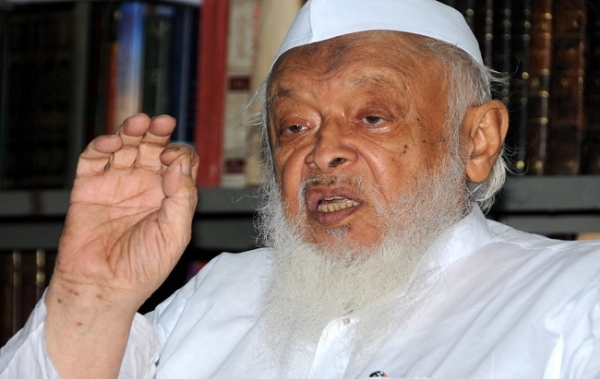
New Delhi, 9 December (H.S.): Jamiat Ulama-e-Hind president Maulana Arshad Madani on Tuesday clarified that Muslims have no objection to others reading or singing Vande Mataram, but take exception to the verses that contradict the principle of monotheism. He said that in Islam, believers worship only one God, Allah, and cannot associate anyone or anything with His divinity.
Madani explained that certain verses of Vande Mataram are based on religious concepts that conflict with the core Islamic belief in monotheism. He particularly referred to the song’s later stanzas, which personify the nation as Goddess Durga and use expressions of worship, something that goes against the fundamental tenets of Islam.
Citing constitutional rights, Madani said that Articles 25 and 19 of the Indian Constitution guarantee every citizen the freedom of religion and expression. “No one can be compelled to chant a slogan, sing a song, or adopt any idea that violates their religious faith,” he asserted.He also pointed out that the Supreme Court has clearly ruled that no citizen can be forced to recite the national song or any composition that contradicts their religious beliefs.
“Loving one’s country is different from worshipping it,” Madani said. “Muslims do not need any certificate to prove their love for this nation. The sacrifices made by the community during India’s freedom struggle and the Jamiat Ulama-e-Hind’s strong opposition to the partition of India are well-documented in history. Their efforts to preserve the country’s unity and integrity after independence cannot be forgotten.”
Reiterating his long-held position, Madani said patriotism is a matter of “sincerity and action, not empty slogans.”
Quoting historical evidence, Madani highlighted that on October 26, 1937, Nobel laureate Rabindranath Tagore had written to Pandit Jawaharlal Nehru suggesting that only the first two stanzas of Vande Mataram be adopted as the national song, as the remaining verses conflicted with the beliefs of monotheistic religions.
Following Tagore’s advice, the Congress Working Committee decided on October 29, 1937, that only the first two stanzas would be officially recognized.“
Therefore, attempts being made today to compel the singing of the entire song while invoking Tagore’s name are not only a distortion of historical fact but also an affront to the nation’s unity,” Madani stated.
---------------
Hindusthan Samachar / Jun Sarkar
09 Dec 2025
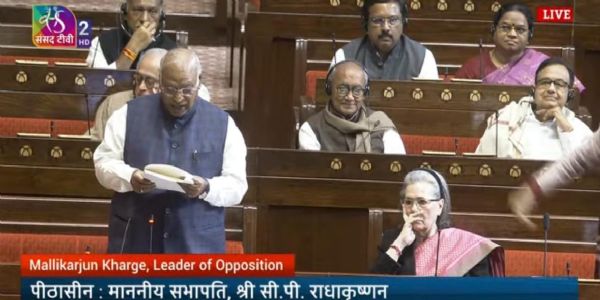
Congress Was the Party That Made ‘Vande Mataram’ a National Call: Kharge Hits Back at BJP in Rajya Sabha

09 Dec 2025