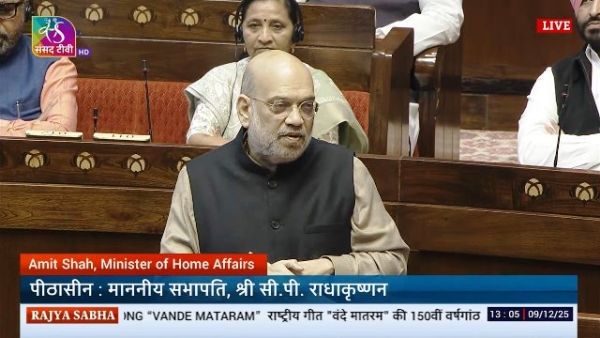
New Delhi, 9 December (H.S.): Union Home Minister Amit Shah on Tuesday said that the discussion on the 150th anniversary of Vande Mataram in both Houses of Parliament will help future generations grasp the song’s real significance, pride, and enduring connection with India’s national consciousness.
Initiating the debate in the Rajya Sabha, Shah emphasized that Vande Mataram is not merely a song but “an eternal emblem of devotion, duty, and surrender to Bharat Mata”—a chant that awakened the country’s collective soul during the freedom struggle.He remarked that during the days of India’s independence movement, Vande Mataram served as the battle cry that inspired the nation to fight for freedom; and in the Amrit Kaal, it will become the mantra for building a prosperous and powerful India.
Shah dismissed attempts to link the discussion to electoral politics in West Bengal, calling such claims an effort to undermine the cultural and historical importance of the song. “Vande Mataram is beyond politics—it is a matter of national pride,” he asserted.
The Home Minister said the timeless relevance of Vande Mataram has endured—from its creation in the 19th century, through the independence movement, and continues even today—and will remain alive when India achieves its vision of a developed nation by 2047.
He recalled that wherever freedom fighters gathered, their meetings would begin with Vande Mataram, and even today, when brave soldiers make the supreme sacrifice at the borders, the last words on their lips are the same—Vande Mataram.
Targeting the Opposition, Shah said that members of the INDIA alliance often leave the House when Vande Mataram is sung in Parliament. Recalling 1992, he noted that when the collective singing of Vande Mataram was revived in the Lok Sabha at the initiative of BJP leader Ram Naik and the insistence of L.K. Advani, several opposition parties had opposed it even then.
Launching a scathing attack on the Congress, Shah said the politics of appeasement had even divided the national song. “Many people like me firmly believe that if Congress had not split Vande Mataram into two parts under the policy of appeasement, India would never have been partitioned—our nation would still have been one,” he declared.
He pointed out that when Vande Mataram marked its 50th year, India was yet to gain independence, but during its golden jubilee after independence, Prime Minister Jawaharlal Nehru limited it to only two stanzas—something Shah described as the beginning of appeasement politics.
In his detailed address, Shah traced the song’s historical evolution and cultural resonance. He said Bankim Chandra Chattopadhyay first presented Vande Mataram publicly on November 7, 1875. Within a short time, it transcended literature to become the spiritual fuel of India’s freedom movement—a mantra of national awakening.
Quoting philosopher Aurobindo, Shah said, “Vande Mataram is the mantra of India’s rebirth.” He recalled that when the British banned the song, Bankim Chandra declared that all his writings could be consigned to the Ganges, but Vande Mataram would live forever as the eternal hymn of India’s reconstruction.
The Home Minister added that India was not forged through wars or treaties, but by its timeless cultural unity—first evoked by Bankim Chandra through Vande Mataram. “India is not just a piece of land—it is a mother to millions, and this spirit is most vividly expressed in Vande Mataram,” he said.
Highlighting the song’s nationwide impact, Shah said Vande Mataram inspired movements from Kashmir to Kanyakumari—from Punjab’s Ghadar revolution to Maharashtra’s Ganapati festivals and Tamil Nadu’s translations by Subramania Bharati. He noted that a newspaper titled Bande Mataram was published in 1907 under the editorship of Aurobindo Ghosh before being banned by the British.
He added that from Lord Rama in the Ramayana to Adi Shankaracharya and Chanakya, India’s sages have celebrated the sanctity of the motherland. Bankim Chandra revived this eternal reverence by depicting Bharat Mata as the combined embodiment of Saraswati, Lakshmi, and Durga.
Shah said that when Vande Mataram completed its centenary, it was denied due respect because, during the Emergency, patriots who chanted it were jailed and the nation was trapped in an atmosphere of repression.Urging lawmakers to rekindle this patriotic spirit among the youth, Shah said, “It is our shared responsibility to sow the values, spirit, and dedication of Vande Mataram in every young Indian’s heart and realize Bankim Chandra’s vision of a glorious India.”
He concluded by emphasizing that the debate on Vande Mataram was not linked to any upcoming election but intended to remind the nation that “this song represents India’s soul—and its echo will continue to inspire the creation of a developed Bharat in the years to come.”
---------------
Hindusthan Samachar / Jun Sarkar
09 Dec 2025
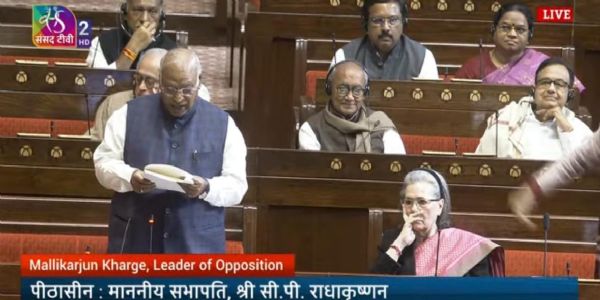
Congress Was the Party That Made ‘Vande Mataram’ a National Call: Kharge Hits Back at BJP in Rajya Sabha

09 Dec 2025